

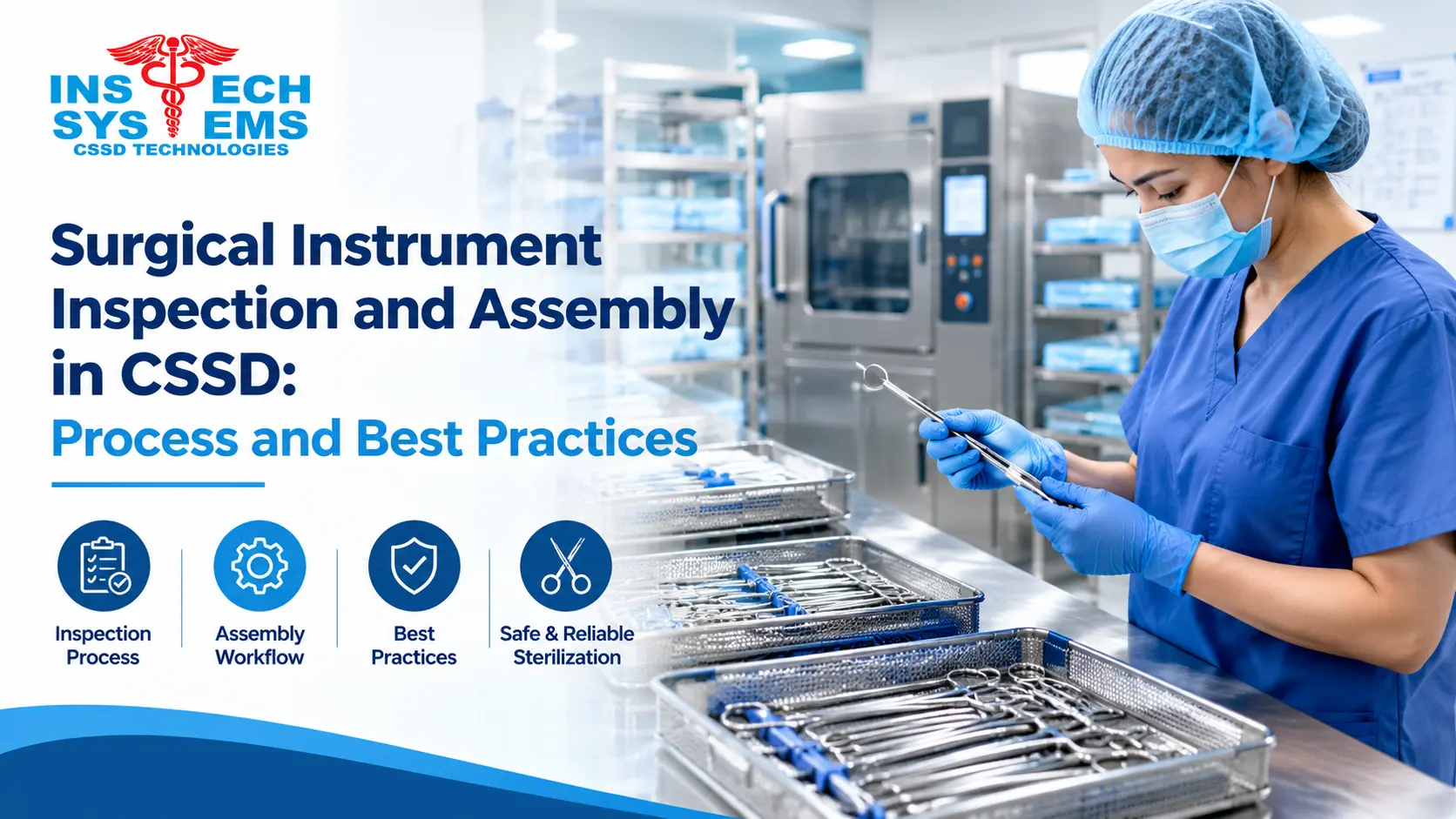
Surgical instruments play a critical role in patient safety and successful surgical procedures. Before instruments are released for use, they must undergo careful inspection, correct assembly, and appropriate preparation for sterilization. Even a small defect, such as a damaged hinge, loose screw, or instrument that does not function smoothly, can affect its performance during surgery.
The Central Sterile Services Department (CSSD) is responsible for ensuring that reusable surgical instruments are properly processed and prepared according to established procedures. Surgical instrument inspection and assembly in CSSD is an essential stage of this process, helping healthcare facilities identify damaged instruments, verify their functionality, and prepare them for safe sterilization.
For hospitals and healthcare facilities, following a structured inspection and assembly process helps maintain instrument quality, improve workflow efficiency, and support infection prevention practices.
What Is Surgical Instrument Inspection and Assembly in CSSD?
Surgical instrument inspection and assembly is the process of examining cleaned surgical instruments for cleanliness, damage, and proper functionality before arranging them into designated instrument sets or trays.
This process generally takes place after cleaning and disinfection and before packaging and sterilization. Instruments are checked individually and then assembled according to the requirements of the intended surgical procedure.
The objective is to ensure that every instrument included in a set is clean, functional, correctly assembled, and suitable for the next stage of sterile processing.
Inspection and assembly must follow the instrument manufacturer’s instructions for use (IFU), the hospital’s approved CSSD procedures, and applicable sterilization requirements.
Also Read: Hospital Autoclave Maintenance Checklist: Daily, Weekly and Periodic Checks
Step-by-Step Process of Surgical Instrument Inspection and Assembly
1. Prepare the Inspection Area
Before beginning inspection, CSSD staff should ensure that the work area is clean, organised, and suitable for handling processed instruments.
The inspection station should have adequate lighting, appropriate magnification equipment, instrument-specific checklists, and the tools required for assembly.
Staff should follow the facility’s PPE and hand hygiene requirements. Cleaned instruments must be handled in a manner that prevents recontamination.
2. Check Instrument Cleanliness
The first step in inspection is confirming that instruments are visibly clean and free from blood, tissue, detergent residue, and other contaminants.
Pay particular attention to difficult-to-clean areas, including:
- Hinges and box locks
- Serrations and teeth
- Joints and connection points
- Cannulations and narrow channels
- Insulated surfaces of specialised instruments
If visible soil or residue is detected, the instrument should be returned for appropriate re-cleaning and subsequent inspection. Instruments should not proceed to assembly or sterilization while cleanliness concerns remain unresolved.
Where required by the facility’s procedures, additional inspection methods may be used to identify residual contamination that is not readily visible.
3. Inspect Instruments for Damage
After confirming cleanliness, each instrument should be examined for physical defects that may affect its safe use.
Common inspection points include:
Corrosion and staining: Check for rust, pitting, discoloration, or surface deterioration that may indicate damage or improper processing.
Cracks and deformation: Examine instrument tips, handles, blades, and joints for visible cracks, bending, or structural damage.
Loose components: Check for loose screws, missing parts, or unstable connections.
Sharpness and alignment: Cutting instruments should be examined for appropriate sharpness and alignment according to the manufacturer’s instructions.
Damaged instruments should be clearly identified, segregated from serviceable items, and sent for repair or replacement through the hospital’s approved process.
4. Test Instrument Functionality
A clean instrument may still be unsuitable for use if it does not function correctly. Functional testing is therefore an important part of CSSD inspection.
For example, scissors should open and close smoothly and demonstrate appropriate cutting performance using the approved testing method. Forceps should align properly at their tips and maintain the required grip. Needle holders should engage securely and release without sticking.
Ratchets, hinges, locks, and movable parts should operate smoothly without excessive resistance or looseness.
Testing should be performed according to the instrument type and manufacturer guidance. Instruments that fail functional checks should not be included in surgical sets.
5. Assemble Instruments According to the Required Set
Once individual instruments pass inspection, they can be assembled into the appropriate surgical set or tray.
Assembly should follow the approved instrument list for the relevant procedure. Staff should verify the correct instrument names, quantities, sizes, and specialised components.
The process may include arranging instruments in a defined sequence to support easy identification and efficient use in the operating room.
Where applicable, hinged instruments should be positioned in the configuration recommended by the manufacturer and the sterilization process. Instruments should not be packed too tightly, as this can interfere with cleaning, sterilant contact, or drying.
Complex or specialised instruments may require additional components, accessories, or assembly steps. These should be completed only by trained staff following the relevant IFU.
6. Verify the Tray and Documentation
Before packaging, the assembled tray should undergo a final verification.
CSSD staff should confirm that:
- All instruments listed on the approved checklist are present.
- Instruments are correctly assembled and arranged.
- No damaged or visibly contaminated instruments remain in the set.
- The tray and its accessories are suitable for the intended sterilization cycle.
- Required identification and traceability information is complete.
Any missing instrument or assembly discrepancy should be resolved before the set moves forward.
Best Practices for Surgical Instrument Inspection and Assembly
Use Standardised Checklists
A checklist for each instrument set helps staff verify quantities, identify missing components, and maintain consistency between shifts.
Checklists should be reviewed whenever instrument sets are modified or new instruments are introduced.
Provide Regular Staff Training
CSSD personnel should receive training in instrument identification, inspection techniques, functional testing, assembly requirements, and handling of specialised devices.
Training should include practical demonstrations and periodic competency assessments.
Follow Manufacturer Instructions
Different surgical instruments may have different cleaning, lubrication, assembly, and sterilization requirements.
Staff should refer to the relevant manufacturer’s IFU rather than applying the same procedure to every instrument.
Maintain Traceability
Instrument sets should be linked to appropriate processing records according to the facility’s tracking system.
Documentation can help identify which sets were processed, who completed the inspection, and whether any instruments were removed for repair or replacement.
Separate Defective Instruments
Instruments that fail inspection should be removed from the assembly workflow and placed in a designated area for repair, replacement, or further assessment.
This prevents defective instruments from accidentally being included in a completed tray.
Common Mistakes to Avoid During CSSD Instrument Assembly
Several avoidable errors can affect the quality of instrument preparation.
- Skipping individual inspection: Checking only the overall tray may allow damaged or malfunctioning instruments to go unnoticed.
- Ignoring manufacturer guidance: Incorrect assembly or handling can damage instruments or affect processing.
- Overloading trays: Excessive instrument quantities or poor arrangement can interfere with effective sterilization.
- Using damaged instruments: Defective items should never be included simply because they are needed to complete a set.
- Incomplete documentation: Missing records can make it difficult to investigate processing issues or track instrument sets.
A structured workflow, clear responsibilities, and regular quality checks help reduce these problems.
How Instech Systems Supports CSSD Requirements
Instech Systems provides solutions for healthcare facilities seeking to improve their sterile processing and CSSD operations. Hospitals planning or upgrading their sterilization departments should consider how equipment, workflow design, staff training, and instrument handling procedures work together.
For effective surgical instrument inspection and assembly, healthcare facilities should focus on suitable inspection workstations, organised instrument handling areas, clear processing procedures, and reliable sterilization equipment.
The right approach depends on the hospital’s instrument volume, types of surgical procedures, available space, and existing sterile processing workflow. Facilities can discuss their CSSD requirements with Instech Systems to evaluate suitable equipment and operational solutions.
Conclusion
Surgical instrument inspection and assembly in CSSD is an important quality-control stage that helps ensure instruments are clean, functional, correctly assembled, and ready for the next stage of sterile processing.
By following standardised checklists, manufacturer instructions, staff training, and proper traceability procedures, healthcare facilities can improve consistency and reduce the risk of damaged or incomplete instruments reaching the operating room.
Instech Systems supports healthcare facilities with CSSD-related solutions to help create organised and efficient sterile processing workflows. Contact the team to discuss your hospital’s CSSD equipment and operational requirements.
Frequently Asked Questions
1. When should surgical instruments be inspected in CSSD?
Instruments should be inspected after cleaning and disinfection and before assembly, packaging, and sterilization.
2. What should be checked during surgical instrument inspection?
Staff should check cleanliness, corrosion, cracks, alignment, sharpness where applicable, loose components, and overall functionality.
3. Why is surgical instrument assembly important?
Correct assembly ensures that the required instruments and components are included in each set and arranged according to the approved procedure and manufacturer’s instructions.
4. What happens if an instrument fails inspection?
The instrument should be segregated from serviceable items and sent for repair, replacement, or further assessment. It should not be included in a surgical set until the issue is resolved.
5. Who is responsible for surgical instrument inspection and assembly?
Trained and competent CSSD personnel perform inspection and assembly according to hospital procedures, manufacturer instructions, and applicable sterile processing requirements.