

Cleaning surgical instruments properly is an essential step in maintaining hygiene and preventing cross-contamination in hospitals, clinics, dental practices, and healthcare facilities. Medical instruments often contain blood, tissue residues, and other contaminants that may be difficult to remove through manual cleaning alone. An ultrasonic cleaner for surgical instruments offers an effective solution by using high-frequency sound waves to remove debris from intricate surfaces, narrow openings, joints, and hard-to-reach areas.
For healthcare facilities that require consistent instrument reprocessing, ultrasonic cleaning can improve cleaning efficiency, reduce manual effort, and support standardized infection prevention procedures. In this guide, we will explain how ultrasonic cleaners work, their benefits, applications, and when healthcare professionals should consider using them.
What Is an Ultrasonic Cleaner for Surgical Instruments?
An ultrasonic cleaner is a specialized cleaning device that uses high-frequency sound waves to remove contaminants from medical instruments immersed in a suitable cleaning solution. It is designed to clean areas that may be difficult to reach with conventional brushes or manual cleaning methods.
An ultrasonic cleaner for medical instruments is commonly used for cleaning surgical scissors, forceps, clamps, dental instruments, reusable surgical tools, and other compatible medical devices.
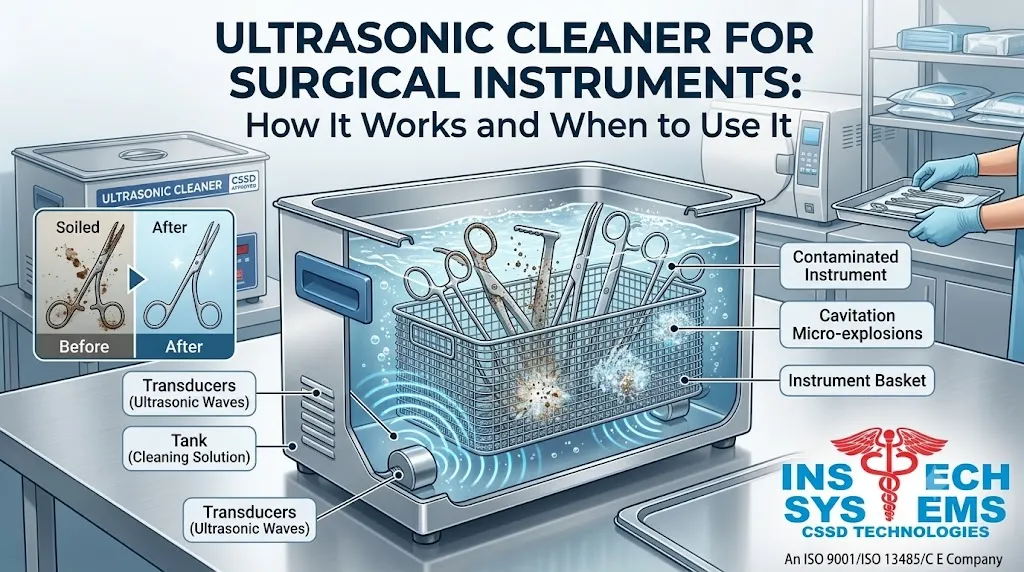
The equipment typically consists of a stainless steel tank, an ultrasonic transducer system, a control panel, and a cleaning solution. Depending on the model, it may also include temperature control, digital timers, adjustable operating settings, and accessories for holding instruments securely.
Unlike ordinary soaking, ultrasonic cleaning produces microscopic bubbles in the liquid that help loosen and remove contaminants from instrument surfaces.
Also Read: What Is an ETO Sterilization Chamber? Complete Guide
How Does Ultrasonic Cleaning Work?
The ultrasonic cleaning process relies on a phenomenon known as cavitation. When high-frequency sound waves pass through a suitable liquid, they create microscopic bubbles that form and collapse rapidly. This action generates localized cleaning forces that help dislodge dirt, organic residues, and other contaminants.
The process generally involves the following steps:
1. Preparation of Surgical Instruments
Before cleaning, reusable instruments should be handled according to the manufacturer’s instructions and the healthcare facility’s infection prevention procedures. Instruments may need to be disassembled, opened, or separated to expose areas where debris can accumulate.
Visible soil should be addressed according to the approved cleaning protocol before placing the instruments into the ultrasonic cleaner.
2. Filling the Cleaning Tank
The tank is filled with a compatible cleaning solution at the concentration and temperature recommended by the equipment and instrument manufacturers. Using an appropriate solution is important because unsuitable chemicals may damage delicate instruments or reduce cleaning performance.
3. Ultrasonic Cavitation
When the equipment operates, its transducers generate high-frequency sound waves through the liquid. These waves produce microscopic bubbles that collapse and help loosen contaminants from joints, serrations, grooves, and other complex surfaces.
This is the main mechanism behind ultra sonic cleaning, allowing the solution to reach areas that are difficult to clean manually.
4. Rinsing and Drying
After the cleaning cycle, instruments are removed carefully and rinsed according to the validated procedure to remove loosened debris and cleaning solution residues. They are then inspected and dried as required before proceeding to the next stage.
5. Inspection and Further Processing
Cleaned instruments should be inspected for remaining soil, damage, and proper functionality. If cleaning is inadequate, the instruments must be reprocessed according to the applicable procedure. Compatible reusable instruments then proceed through the required disinfection or sterilization process before reuse.
Key Benefits of an Ultrasonic Surgical Instrument Cleaner
Choosing an appropriate ultrasonic surgical instrument cleaner can help healthcare facilities improve their instrument-cleaning workflow.
Effective Cleaning of Complex Instruments
Surgical instruments often contain hinges, narrow spaces, serrations, and intricate surfaces. Ultrasonic cavitation helps cleaning solutions reach these difficult areas, supporting more consistent removal of contaminants when the equipment is used correctly.
Reduced Manual Cleaning Effort
Manual cleaning can be time-consuming, particularly when healthcare staff handle large volumes of reusable instruments. Ultrasonic cleaning can reduce repetitive brushing requirements for compatible devices and help streamline instrument reprocessing.
Improved Cleaning Consistency
Manual cleaning results can vary depending on technique and operator performance. Using a validated ultrasonic cleaning process with appropriate solution concentration, temperature, and cycle duration helps establish a more standardized cleaning routine.
Suitable for Different Healthcare Settings
Depending on tank capacity and equipment specifications, ultrasonic cleaners can support the cleaning requirements of hospitals, dental clinics, surgical centres, laboratories, and other healthcare facilities.
Better Workflow Efficiency
When integrated into a well-designed instrument reprocessing area, ultrasonic cleaning can help improve workflow organization and reduce the time spent on selected cleaning tasks. The actual improvement depends on instrument volume, equipment capacity, cycle time, and operating procedures.
When Should You Use an Ultrasonic Cleaner for Medical Instruments?
An ultrasonic cleaner for medical instruments is useful when reusable devices have intricate surfaces or areas where contaminants are difficult to remove manually. However, the suitability of ultrasonic cleaning depends on the instrument manufacturer’s instructions.
Common situations where this equipment may be appropriate include:
- Cleaning hinged surgical instruments: Scissors, forceps, and clamps may have joints where soil can accumulate.
- Processing dental instruments: Compatible dental instruments with grooves and complex surfaces may benefit from ultrasonic cleaning.
- Cleaning instruments with serrated surfaces: Cavitation can help loosen debris from serrations and textured areas.
- Handling high volumes of reusable instruments: Hospitals and surgical centres may use ultrasonic cleaning as part of a structured reprocessing workflow.
- Supporting routine instrument reprocessing: The equipment can serve as a cleaning step before inspection, packaging, and subsequent sterilization.
Always verify that an instrument is suitable for ultrasonic cleaning. Certain delicate devices, optical components, powered instruments, and specialized medical equipment may require alternative methods.
Ultrasonic Cleaning vs. Ultrasonic Sterilization: What Is the Difference?
The terms ultrasonic cleaning and ultrasonic sterilization are sometimes used interchangeably, but they describe different processes.
Ultrasonic cleaning removes contaminants from instrument surfaces using cavitation and an appropriate cleaning solution. It prepares instruments for subsequent reprocessing but does not, by itself, establish that they are sterile.
Sterilization is a validated process designed to eliminate all forms of viable microorganisms, including bacterial spores, to the required level of assurance. Medical instruments must undergo an appropriate, validated sterilization process when required by their intended use and applicable guidelines.
Therefore, ultrasonic cleaning should not be considered a replacement for a steam sterilizer, an ethylene oxide sterilizer, or another suitable validated sterilization system. Healthcare facilities should follow the instrument manufacturer’s instructions and applicable infection prevention requirements.
Important Features to Consider Before Buying an Ultrasonic Cleaner
Selecting the right equipment requires an understanding of the facility’s instrument types, workload, and cleaning procedures.
Tank Capacity and Dimensions
Choose a tank that accommodates the size and quantity of instruments processed per cycle. Instruments should be arranged appropriately without overcrowding, allowing the cleaning solution to contact the required surfaces.
Ultrasonic Frequency and Cleaning Performance
Ultrasonic frequency affects cavitation characteristics and cleaning performance. The appropriate configuration depends on the instrument type, contaminant, and manufacturer’s recommendations. Higher frequency is not automatically better for every application.
Temperature and Timer Controls
Adjustable temperature and cycle duration can help operators follow the required cleaning parameters. The settings should remain within the limits specified for both the instruments and cleaning solution.
Construction and Material Quality
A robust stainless steel tank is commonly preferred in healthcare cleaning environments because it offers durability and ease of maintenance. The overall design should support routine cleaning and safe operation.
Safety and Ease of Operation
Look for accessible controls, clear operating instructions, suitable drainage arrangements, and safety features appropriate to the intended environment. Digital controls and cycle monitoring may also be useful depending on the model.
Technical Support and Maintenance
Before purchasing, consider the supplier’s technical guidance, maintenance support, spare-parts availability, and assistance with equipment operation. These factors can contribute to reliable long-term performance.
Applications of Ultrasonic Cleaning in Healthcare
Ultrasonic cleaning equipment can support several healthcare and laboratory applications when used with compatible devices.
- Hospitals: Cleaning suitable reusable surgical instruments before further processing.
- Dental clinics: Cleaning compatible dental tools with intricate surfaces.
- Surgical centres: Supporting organized instrument reprocessing workflows.
- Medical laboratories: Cleaning compatible tools and equipment components.
- Healthcare equipment processing units: Handling selected reusable instruments according to validated procedures.
The cleaning method must always be selected according to the device’s design, intended use, and reprocessing instructions.
Why Choose Instech Systems for Ultrasonic Cleaning Equipment?
Healthcare facilities need equipment that supports efficient cleaning, dependable operation, and practical workflow management. Instech Systems can be considered for ultrasonic cleaning equipment based on the facility’s instrument-processing requirements and the specifications of the available models.
Before selecting an ultrasonic cleaner, buyers should assess tank capacity, operating controls, compatible cleaning solutions, instrument compatibility, maintenance requirements, and technical support.
For hospitals, clinics, and healthcare equipment procurement teams, choosing the right configuration is more important than selecting a machine based on capacity or price alone. Discussing the intended application and daily instrument volume with the supplier can help identify a suitable solution.
Contact Instech Systems to enquire about available ultrasonic cleaning equipment, technical specifications, and options for your instrument-cleaning requirements.
Frequently Asked Questions
1. What is an ultrasonic cleaner for surgical instruments used for?
It is used to remove contaminants from compatible reusable surgical instruments using high-frequency sound waves and a suitable cleaning solution. It supports the cleaning stage of instrument reprocessing.
2. Does ultrasonic cleaning sterilize medical instruments?
No. Ultrasonic cleaning removes soil and contaminants but does not replace a validated sterilization process. Instruments must undergo the appropriate subsequent processing required for their intended use.
3. Which medical instruments can be cleaned using an ultrasonic cleaner?
Compatible scissors, forceps, clamps, dental instruments, and other reusable devices may be cleaned ultrasonically. Always check the instrument manufacturer’s instructions before processing.
4. How long does ultrasonic cleaning take?
Cycle duration depends on the instrument type, cleaning solution, level of contamination, equipment settings, and validated cleaning procedure. Follow the equipment manufacturer’s instructions rather than using a universal cycle time.
5. How do I choose the right ultrasonic cleaner for medical instruments?
Consider tank dimensions, instrument volume, ultrasonic frequency, temperature and timer controls, compatibility requirements, ease of maintenance, and supplier support.
Conclusion
An ultrasonic cleaner for surgical instruments can be a valuable part of an effective healthcare instrument-reprocessing workflow. By using cavitation to loosen contaminants from difficult-to-reach surfaces, ultrasonic cleaning supports more consistent cleaning while reducing some of the effort associated with manual methods.
The best results depend on selecting compatible equipment, following validated cleaning procedures, and inspecting instruments before further processing. Remember that ultrasonic cleaning is a cleaning method, not a substitute for sterilization.
For healthcare facilities looking to improve their instrument-cleaning process, Instech Systems can be approached to discuss suitable ultrasonic cleaning equipment and technical requirements.


Pingback: Medical Instrument Cleaning Before Sterilization: Steps and Best Practices